What Leaves the Device: Offline Confidential Software Before AI Use
November 17, 2026
Policies, data-processing agreements, and enterprise-tier settings are contractual controls for AI privacy. They allocate liability after a vendor has already received the file. Offline confidential software is the technical control in front of that boundary: identifiers are removed or tokenized on the device, and the model processes placeholders.
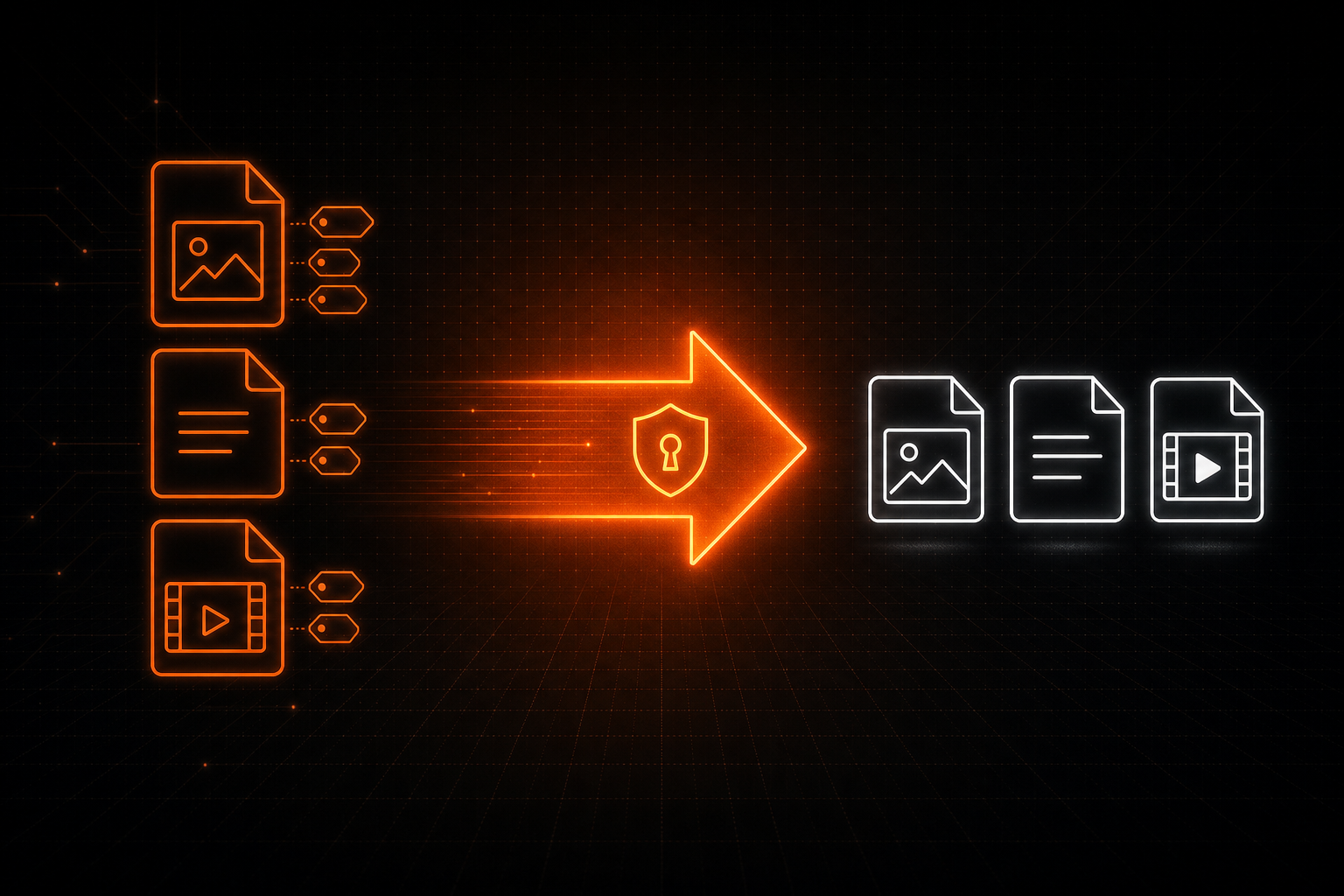
Contractual controls are vendor-side.
A limited-retention clause, regional processing addendum, and toggle that disables training are helpful and should be required, but they answer a different question from the one a CISO or an AI transformation lead has to answer:
What has already been provided externally?
If the answer is the raw original, the remaining controls are promises by a third party: logging configuration, subprocessors, backup retention, support-access paths, and whatever an administrator can change after the contract is signed.
The same limit applies to shadow AI tools. Blocking the hostname does not sanitize the draft someone already uploaded from a personal login. A pre-AI step that runs locally on the laptop is independent of whether an approved or unapproved service is used.
A DPA governs what a recipient claims it will do with data it holds. Pre-AI data sanitization decides whether that recipient ever holds the identifiers. AI data leakage prevention that only lives in the contract still assumes the leakable content was sent.
Any cloud compliance service MUST receive the raw input
Cloud-based masking and transcription means that the raw file must be transmitted externally. A later deletion job, a "we do not train" setting, or a SOC report does not rewind it.
Server compromise then exposes the highest-sensitivity artifacts. Logs, object storage, queue payloads, crash dumps, and a subprocessor that retains "for quality" are all places that original can sit. The attack surface is broadened to these third parties.
Audio and video are the rawest inputs in this model. A recording carries unfiltered names, voices, emotions and identifiers, and backgrounds. Sending that file to a meeting bot or a cloud speech API is a full disclosure of the session, plus whatever the vendor's note-taker product does with it. The professional-ethics side of recording tools is covered separately in AI Note-Taker Risks and Legal Ethics and AI. The control question with CamoVoice is narrower: who must hold the recording in order to produce text.
Transcribing locally with CamoVoice is a metadata-mediation step. The recording stays on hardware the organization administers. What can leave is a transcript a person has reviewed. That transcript is also the format most model integrations can accept. Many approved tools still cannot take audio or video as input, and a raw recording is an expensive way to buy tokens even when they can. A local transcript cuts that volume to the words, and only the words you choose to send.
A hosted sanitizer or transcription vendor is in possession of the unredacted original for as long as processing, logging, and backups require. A local tool never places that original on a separate server.
A technical control: placeholders, produced locally
With CamoText, detection and replacement run on the installed application. Names and other identifiers are removed or replaced with stable placeholders before a prompt is assembled. The external model, sanctioned or shadow, processes using those placeholders. Relationships in the text can survive, because the same party remains the same token.
That is pre-AI data sanitization as an architectural step. It is also why the preparation can stay platform-agnostic: procurement can change the model without rebuilding the control that sits in front of it. The practical document workflow is set out in Preparing Confidential Documents for AI Review. Why masking, transcription, and conversion do not belong on a SaaS web app is set out in Confidential Work Must Stay Local.
CamoText International anonymizes natively in English, French, German, Spanish, and Italian, which covers the document languages law-firm and public-sector teams in the US, UK, EU, Canada, and Australia often mix on one matter. CamoVoice International transcribes in nine languages on the same fully local pattern.
Private-by-design is a smaller attack surface you can test
CamoText and CamoVoice are fully bundled desktop applications. After installation they do not need an account, a telemetry channel, or a call home to function. There is no server-side corpus of customer documents or recordings to breach, because CamoSuite products are fully offline. "Verify, don't trust" here is operational, not a slogan:
- Install from the package on a machine with no network, and confirm the task still completes.
- During a normal run, deny outbound traffic or take a packet capture. The expected result is no application egress.
- Confirm there is no content log shipped off-box, and no vendor console holding the file.
A security team can run those checks itself. The honest description of the outcome is a smaller attack surface. The laptop, the user, and the path they later choose for the sanitized text remain in scope. What drops out of scope is a multi-tenant sanitization or transcription tier that had to be trusted with the original.
Private-by-design AI preparation is zero-egress only if a deny-all firewall or a capture during use shows no payload leaving. If the product must phone home to license, update, or "process in region," the measurement already failed.
Limits, stated as limits
Detection is probabilistic and context-dependent. Models miss names, over-flag ordinary words, and handle codes, nicknames, and mixed-language files unevenly. Professional human review remains required before external use, as it always has for anything leaving a matter or a case file. One cannot fully automate a subjective process like confidential term detection.
Masked text can still be re-identifiable. A unique transaction, a small jurisdiction, or a fact pattern known to the recipient can point back to a person even when the name token is stable. Sanitization reduces what an AI vendor and its subprocessors hold.
The control complements AI governance, DPAs, and access control. You still decide which tools are approved, which staff may use them, how long prompts may be retained on the model side, and how outputs are checked before they re-enter the file. Local preparation is the step that makes those other controls apply to placeholders rather than to the raw file.
Vendor and procurement checklist
Use this when evaluating any pre-AI sanitization or transcription tool, including CamoText and CamoVoice.
- Intake. Must the vendor receive the unredacted original, recording, or metadata in order to return a masked or transcribed result?
- Egress test. Can your team install offline, then deny-all or packet-capture during a real document and a real recording, with no account creation and no telemetry host?
- Server-side residue. After the job, is there a customer tenant, log, backup, or support-access path that still contains source content? "Zero retention" needs a deletion scope: prompts, files, audio, embeddings, and crash dumps.
- Placeholders, not black bars on the original. Does the tool emit a new working copy with stable tokens, so the model can follow parties and cross-references without receiving identity strings?
- Human review is a feature. Can a reviewer correct misses and false positives, and can that configuration be reused across a matter, before anything is cleared for external use?
- Language and media coverage matches the work. For mixed language matters, confirm native anonymization for the document languages in play, and local transcription where meetings are not English-only. Confirm the tool does not require a cloud pass for audio the approved AI stack cannot ingest.
Where this sits for firms, agencies, and the consultants who advise them
Law firms and public-sector bodies are adopting models faster than they are shrinking what those models are given. Consultants who own the design of that adoption need a control they can drop in without waiting on each vendor's enterprise paperwork, and that still works when a staff member reaches for a tool the policy does not name.
CamoSuite is that layer: CamoText for local anonymization, CamoVoice for offline transcription, and CamoConvert for local file conversion. No subscription meter on the sanitization step, and nothing server-side that holds the client's file. Practice-specific notes are on the solution pages for law firms, the public sector, and consultants.
FAQ
Does a zero-retention DPA stop confidential data from leaving the device?
No. A DPA, enterprise-tier setting, or zero-retention clause is a contractual control over what a vendor says it will do after it receives data. It does not change the bytes that leave the laptop. If the original file or recording is uploaded, the unredacted content has already left the device, regardless of the retention promise that follows.
Why is a cloud sanitizer or transcription service a weaker control if they're more accurate than a local app?
A cloud sanitizer or transcription service must receive the unredacted original in order to mask or transcribe it. A compromise of that service, its logs, backups, or subprocessors exposes the raw material, not the placeholders. Local sanitization and transcription mean the external AI path receives placeholders or a transcript you have already reviewed, and professionals should review and adjust the results in either case.
How can a security team verify that CamoText and CamoVoice do not egress data?
The apps are fully bundled and run after installation with no account and no telemetry. A security team can install offline, deny all outbound traffic or capture packets during a real task, and confirm there is no server-side store of documents or recordings to attack. That is a check the team runs itself, not an attestation it has to take on trust. The result is a smaller attack surface. The laptop and the path chosen for the sanitized text remain in scope.
Does local masking replace human review, DPAs, and access control?
No. Detection is probabilistic and depends on context, so a professional still reviews the output before anything is sent externally. Masked text can remain re-identifiable from surrounding facts. Pre-AI sanitization complements AI governance, DPAs, and access controls, rather than replacing.